

Epoxy Flooring & Concrete Polishing Costs in Eastern Iowa
What should you expect to pay to coat, polish, or reseal your concrete?
This guide lays out real planning numbers from Decorative Concrete Surfaces, the same figures we use when we quote garages, basements, shops, and patios across Cedar Rapids, Iowa City, and the surrounding communities. You'll see per-square-foot rates, complete project examples, and the specific conditions that move a price up or down, so you can walk into an estimate already knowing what matters.
- Locally owned since 2004
- Thousands of completed projects
- Residential & commercial
- Serving Cedar Rapids & Iowa City
Quick answer: Most new garage epoxy floors in Eastern Iowa start around $7 to $8 per square foot, and diamond grinding or polishing typically runs $6 to $10 per square foot. The final number depends on the condition of your concrete more than anything else: cracks, spalling, joint caulking, old coatings that need removal, and the finish you want all change the price. Square footage sets the baseline; prep work sets the rest.
Concrete pricing frustrates a lot of homeowners because two garages that look identical from the driveway can come in hundreds of dollars apart. The difference is almost never the square footage. It's what the floor has been through: settled slabs that cracked, surface spalling from years of road salt, control joints that were never caulked, or a peeling coating from a previous DIY kit that has to be ground off before anything new can bond.
This guide walks through what each of our core services costs, why the ranges are ranges, and what you can do to get a tighter number quickly. We've included two recent projects with actual invoiced amounts so the figures aren't abstract.
One honest caveat before the numbers: everything here is a planning range, not a quote. Your floor's condition, layout, and finish choices determine the final price, and we confirm all of it with a free on-site evaluation before any work begins.
Where projects land on the cost scale
Here's how typical projects compare, from a small exterior resealing visit to a large polishing job. The two-car garage figure is our most commonly quoted project; the smallest and largest bars come from recent completed work.
- Exterior resealing & refurbishment
- Garage epoxy
- Diamond polishing
-
Small patio resealingunder $800
-
1-car garage epoxy (about 300 sq. ft.)$2,100–$2,400
-
2-car garage epoxy (about 600 sq. ft.)$4,200–$4,900
-
3-car garage epoxy (about 900 sq. ft.)$6,300–$7,200
-
Multi-surface exterior refurbishmentabout $7,000
-
1,000 sq. ft. diamond polishing$6,000–$10,000
Garage sizes above use common square footages (a two-car garage is roughly 600 square feet) multiplied by our standard epoxy rate, which is why they scale so predictably. The exterior projects don't follow a per-square-foot formula because labor, surface condition, and the number of distinct surfaces matter more than raw area. That's covered in the project examples below.
Quick cost estimator
Pick the details that match your project and get a planning range built from the same rates we quote with. Every dropdown has a "Not sure" option, and choosing it simply widens the range instead of blocking you. Nothing here asks for your email, and nothing is a commitment.
- Square footage sets the baseline at our standard garage epoxy rate.
- A solid slab keeps prep light, which holds the range tight.
- Flake, color, and topcoat choices fine-tune the final figure.
What actually changes the price
Every estimate we write starts from the same short list of variables. Here they are at a glance, then explained properly below.
Square footage
Sets the baseline. Materials and machine time scale directly with area.
Floor condition
Cracks, pitting, and spalling need repair before anything bonds.
Existing coatings
Old epoxy or paint has to be ground off completely first.
Joint caulking
Control joints often need cleaning and fresh caulk.
Finish & sheen
Higher gloss means more polishing passes and more time.
Repairs & prep
Quoted as separate line items after we inspect the slab.
Floor condition is the big one
Concrete in Eastern Iowa takes real abuse. Freeze-thaw cycles work moisture into small surface flaws and pop them open, road salt dripping off vehicles eats at the surface, and slabs poured decades ago often have settling cracks running corner to corner. None of this rules out a beautiful floor. It just means repair work comes first, and repair work is labor, so it shows up on the estimate as its own line.
Spalling deserves a special mention because homeowners often mistake it for a cosmetic problem. When the top layer of concrete flakes away, the exposed material underneath is weaker and more porous. Coating over it without patching guarantees the new floor fails early. We patch and level those areas so the epoxy bonds to sound concrete everywhere.
Existing coatings change polishing math
Grinding off an old coating is slow, deliberate work. The diamond tooling that removes a failed epoxy or paint layer wears faster and cuts slower than tooling running on bare concrete, which is why coated floors land in the upper part of the $6 to $10 per square foot polishing range while bare slabs tend to price closer to the bottom of it.
Joint caulking is small but it adds up
Control joints are the grooves cut into a slab so it cracks where the installer wants instead of where it pleases. Over time the caulk in those joints dries out, splits, or goes missing entirely. Cleaning and re-caulking joints protects the floor and gives coatings a clean edge to finish against, and the amount of joint footage in your space is one of the first things we measure.
Sheen is a choice, not a surprise
With polished concrete, the level of shine is produced mechanically: each successively finer grit pass raises the sheen. A satin finish takes fewer passes than a mirror-like high gloss, so your finish choice directly moves labor time. We'll show you samples at the consultation so you can weigh the look against the number.
Real project pricing from recent work
Per-square-foot rates are useful for interior floors, but exterior resealing and refurbishment jobs don't follow a clean formula. The surfaces vary too much: a porch, a sidewalk, and a patio on the same property can each be in different condition and need different products. So instead of publishing a formula that would mislead you, here are two recent completed projects with their actual invoiced amounts.
| Project | Scope | Invoiced | What drives this number |
|---|---|---|---|
| Residential patio resealing | Single patio, cleaned and resealed over two short visits | Just under $800 | Small area and sound surface kept labor to a couple of hours each day |
| Porch, sidewalk & patio refurbishment | Porch staining, sidewalk resealing, back patio resealing and re-antiquing | $7,000 | Three separate surfaces, decorative re-antiquing, roughly two full days of work |
Notice what separates the two: the second project started as a single porch staining inquiry and grew once the homeowner saw what refreshing the adjacent surfaces would do for the whole property. That's common. If you're thinking about one surface, it costs nothing to have us look at the others while we're standing there, and bundling surfaces into one mobilization is more efficient than booking them separately.
Why we look at the floor before we lock the price
A phone estimate based on square footage alone would be easy to give and frequently wrong. The problems that move a concrete price are mostly invisible from a text message: moisture coming up through the slab, hollow spots under the surface, hairline cracks that telegraph through coatings, or a previous coating that looks fine but is barely hanging on.
Our evaluation is free and usually quick. We check the slab's condition, measure the space and joint footage, talk through finish options, and then put a firm number on paper. The ranges in this guide get you oriented; the walkthrough gets you a price you can actually plan around.
Maintenance: protecting what you paid for
Epoxy and polished floors are low-maintenance, not no-maintenance. Grit tracked in on tires acts like sandpaper underfoot, and winter brings a steady drip of salt and slush that should be rinsed off rather than left to sit through the season. A soft broom or dust mop weekly and an occasional wash keep most floors looking new for years.
For garages that work hard, we also offer a dedicated garage floor deep cleaning service that restores coated and bare floors without harsh chemicals. And exterior surfaces benefit from periodic resealing; the patio project in the table above is exactly that kind of visit. If you're not sure whether your sealer is still doing its job, pour a little water on the surface. If it soaks in and darkens the concrete instead of beading, it's time to talk about resealing.
Reseal or refurbish: which does your exterior concrete need?
These two paths get confused a lot, and the price difference is significant, so it pays to know which conversation you're in before you start collecting quotes.
Resealing
The right call when the concrete itself is sound and the color still suits you, but the protective layer has worn away. It's a clean-and-recoat process, usually done in short visits, and it's the least expensive way to extend a surface's life. The patio example above sat in this category.
Refurbishment
The right call when the surface looks tired: faded color, patchy old sealer, staining that cleaning won't lift. Refurbishment can include staining, re-antiquing to restore decorative texture contrast, and resealing across multiple surfaces. More labor, bigger transformation.
A useful rule of thumb: if you'd be happy with your concrete exactly as it looks today, just shinier and protected, you're probably resealing. If you catch yourself wishing it looked different, you're probably refurbishing. Treat that as a conversation starter rather than a verdict; plenty of projects sit in between, and the walkthrough settles it.
Epoxy or polished concrete: choosing the right system
The two flagship interior options overlap in price but solve different problems, and the right choice depends on how the space gets used.
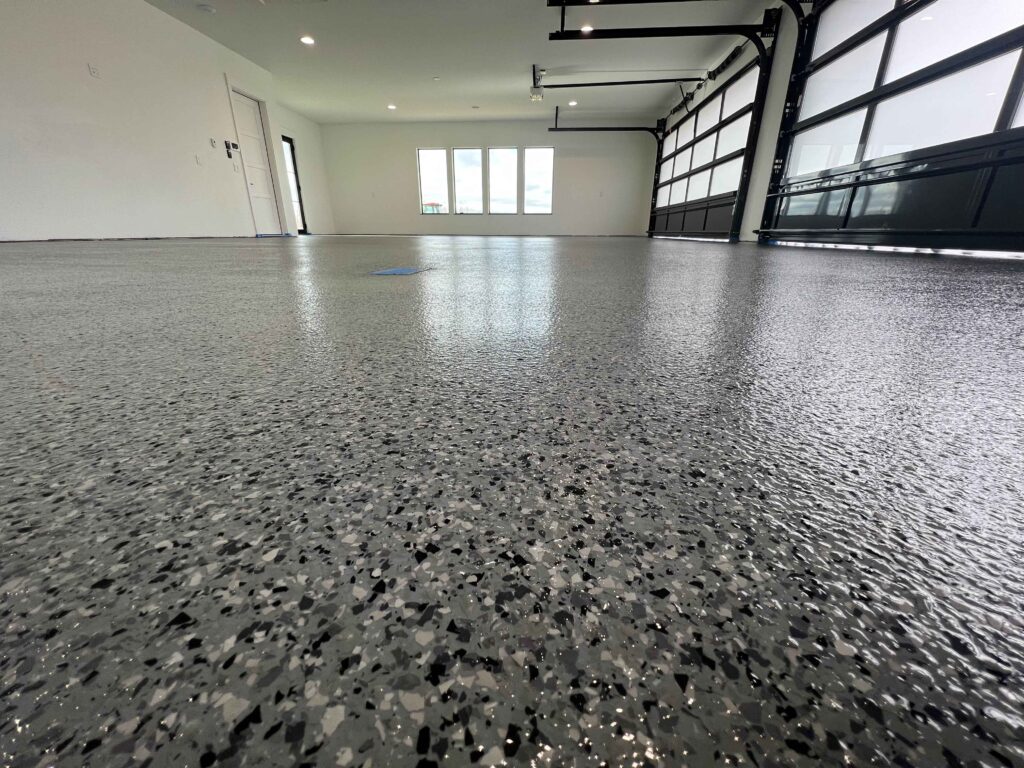
Epoxy flooring builds a protective layer on top of the slab. It's the go-to for garages because it shrugs off hot tire pickup, oil, road salt, and chemical spills, and the flake finishes hide dust and dirt between cleanings. If your floor has cosmetic damage, epoxy also does the best job of concealing repaired areas under a uniform finish.
Diamond polished concrete refines the slab itself rather than covering it. There's no coating to chip or peel, which is why it's popular for basements, retail spaces, and commercial floors that see constant traffic. The look is sleek and architectural, and maintenance is about as simple as flooring gets.
Cost-wise, the ranges overlap enough that the decision rarely comes down to price alone. A bare slab in good condition polishes economically; a stained, patched garage floor usually makes more sense under epoxy. We'll give you a number for both at the evaluation if you're genuinely torn.
What about concrete staining?
Staining is the one service where we deliberately don't publish a price range, and the reason is simple honesty: staining projects vary too much for a published number to mean anything. The labor depends on the surface's condition and how it takes color, the scope can run from a single porch to a whole patio system, and decorative techniques like re-antiquing add passes of work that a flat rate can't capture.
Rather than print a range wide enough to be useless, we quote every staining project individually after seeing the surface. The $7,000 project in the table above included porch staining as one component, which gives you a sense of how staining folds into a larger refurbishment. If staining is on your mind, request an estimate and we'll put a real number on your actual concrete.
Questions worth asking any concrete contractor
Ask these before you approve work, from us or anyone else. Good contractors answer them happily; vague answers are your cue to keep shopping.
- How will you prep the surface, and is grinding included in the price?
- What happens if you find cracks or spalling after you start?
- Is joint caulking part of this quote or a separate line?
- What coating system are you using, and why that one for my floor?
- How long before I can park on or use the floor?
- What does maintenance look like in year three, not just year one?
Why homeowners and businesses choose Decorative Concrete Surfaces
Decorative Concrete Surfaces has been independently owned and operated by Doug Pusteoska since 2004, with thousands of completed projects across Eastern Iowa in that time. The work spans residential garages and basements through commercial floors and sport courts, all built on the same habits: clean prep, protected worksites, quality materials, and finishes that hold up years after we've packed the trailer.
Pricing follows the same philosophy. The evaluation is free, the estimate is itemized so you can see exactly where the money goes, and the number we agree on is the number you pay. No pressure, no games with the figures in this guide.
Where we work
We price and build concrete projects across the Cedar Rapids and Iowa City corridor. If your town isn't listed, check the full service areas page or just ask.
Frequently asked pricing questions
How much does garage epoxy flooring cost in Cedar Rapids and Iowa City?
A new garage epoxy floor typically starts at $7 to $8 per square foot, which puts a standard two-car garage of roughly 600 square feet in the $4,200 to $4,900 range. Floors with cracks, spalling, or an old coating need additional prep, which is quoted as separate line items after we inspect the slab.
What does diamond polished concrete cost?
Diamond grinding and polishing typically runs $6 to $10 per square foot. Bare concrete in good condition prices toward the lower end, while floors with an existing coating to remove, heavy joint caulking needs, or a high-gloss finish target land toward the upper end.
Why do you give a range instead of one price?
Because the two biggest cost variables, slab condition and prep work, can't be measured from a phone call. The range covers what typical floors cost; the free on-site evaluation is what turns the range into a firm, itemized quote for your specific floor.
What makes an epoxy floor cost more than the starting rate?
Cracks, pitting, and spalling that need repair, old coatings that must be ground off, joints that need cleaning and fresh caulk, and premium finish options. Each is quoted as its own line so you can see exactly what you're paying for and why.
Does an old coating have to come off before polishing or recoating?
Yes. New coatings and polished finishes only perform when they bond to sound, open concrete. Grinding off a failed coating is slower work than grinding bare slab, which is the main reason previously coated floors price higher.
How much does concrete staining cost?
We quote staining individually rather than publishing a range, because labor, surface condition, and project scope vary too much for a printed number to be honest. Every staining estimate follows a free look at the actual surface.
What does exterior resealing cost?
It depends on the number of surfaces and their condition. As real reference points, a recent single-patio resealing came in just under $800, while a larger project covering porch staining, sidewalk resealing, patio resealing, and re-antiquing invoiced at $7,000 over roughly two days.
How long does a typical project take?
Small resealing visits can be a couple of hours a day across two days, and the larger multi-surface refurbishment above took about two days of work. Interior epoxy and polishing timelines depend on square footage, repairs, and cure times, so we confirm the schedule at the evaluation.
Is polished concrete cheaper than epoxy?
Sometimes, but the ranges overlap enough that condition decides it. A clean, bare slab often polishes economically, while a stained or patched garage floor usually makes more sense under epoxy. If you're torn, we'll price both options at the same visit.
Do you charge for estimates?
No. The consultation and surface evaluation are free, and the estimate you receive is itemized so the prep, materials, and any repair work are all visible as separate lines.
Can you coat over cracks without repairing them?
We won't, because cracks telegraph through coatings and reappear in the new surface, and unrepaired spalling leaves the coating bonded to weak material. Repairing first costs a little more up front and is the difference between a floor that lasts and one that fails early.
Why can't you quote my floor from square footage over the phone?
Square footage only sets the baseline. Moisture in the slab, hollow spots, hairline cracks, joint condition, and old coatings all change the work required, and none of them are visible over the phone. The walkthrough is quick and it's what makes the final number reliable.
Ready for a real number on your concrete?
Tell us about your garage, basement, patio, or commercial floor and we'll schedule a free evaluation. You'll get an itemized estimate built on the same rates in this guide, matched to your floor's actual condition.